
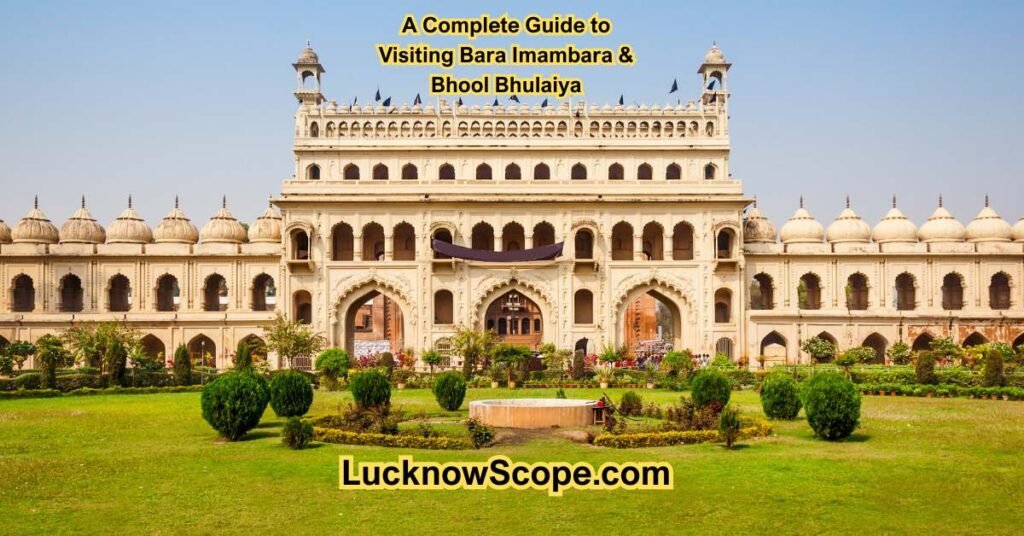
(By Archana Tyagi — Lucknow’s Local Travel Guide)
Introduction
Whenever someone asks me, “Archana ji, where should I start exploring Lucknow?” — I smile and say, “Start from the heart — start from Bara Imambara.” Because this monument is not just a building… it is an emotion. It is the pride of Lucknow. It is the place where history still whispers through its walls and every corner narrates a story of our glorious Nawabi past.
Bara Imambara — a masterpiece built without using iron or cement — stands like a symbol of hope, faith, and Lucknow’s resilient spirit. It is a blend of devotion and architecture, created to provide employment during one of the toughest times in Awadh’s history — the devastating famine of 1784. Inside its premises lives another marvel — the Bhool Bhulaiya, India’s most mysterious labyrinth with nearly 1,000 passageways (though only 400+ are accessible now). A place where even the biggest explorers find themselves scratching their heads!
Whether you are a history lover, an architecture enthusiast, or simply someone who wants to experience the charm of Lucknow — this heritage complex has something unique to offer you.
From the majestic central hall — one of the largest arched halls in the world without pillars — to the thrilling maze on the upper floors, the Imambara complex takes you on a journey into the world of Nawabs, Mughlai imagination, and old Lucknow’s tehzeeb.
In this guide, I will walk you through:
- The fascinating history of Bara Imambara
- The mystery behind the Bhool Bhulaiya
- Secrets, tips, and everything you must know before visiting
So, pack your curiosity — and let’s begin a walk through time with me, your local friend from Lucknow. 😊
History of Bara Imambara
The story of Bara Imambara begins in the late 18th century with Nawab Asaf-ud-Daula, the fourth Nawab of Awadh. In 1784, our region was hit by one of the most severe famines in history. Thousands of people were left hungry, jobless, and hopeless. And this is where the Nawab’s humanity shines the brightest.
To support his people, Asaf-ud-Daula launched the construction of a grand building — not only to create a mark of devotion but to ensure daily wages for those suffering. A famous saying from that time beautifully captures his generosity:
“Jisko na de Maula, usko de Asaf-ud-Daula”
(One who doesn’t receive blessings even from God, Asaf-ud-Daula takes care of them)
Under architect Kifayatullah, the Imambara was designed with brilliance that amazes even engineers today. The central hall — measuring about 50 meters long and 15 meters high — is built with interlocking bricks and no supporting beams, making it one of the world’s largest vaulted halls without pillars.
Its purpose was religious and social. As a Shia congregation hall, the Imambara hosts important ceremonies, especially during Muharram. But its role in feeding and helping thousands during the famine makes it a monument of compassion too.
Construction was carried out in a unique way:
- Highly skilled workers built the structure during the day
- Poor laborers were employed to dismantle parts at night
This ensured that employment continued for as long as possible. What a beautiful way to preserve dignity while giving support!
Architecturally, Bara Imambara reflects the Mughal and Awadhi style — but with a simplicity that keeps it distinct from overly decorated monuments like Mughal palaces. The huge main arched hall, the imposing gateways, the long corridors, and carefully carved entrances all speak of elegance without shouting for attention.
The complex also includes a mosque, stepwell (Shahi Baoli), and sprawling courtyards where one can easily feel the old-world vibe of Lucknow. The entire structure symbolizes innovation — built without iron, without cement, yet strong enough to stand firm for centuries.
Today, Bara Imambara is not only a heritage site — it is a reminder of human compassion, architectural mastery, and Lucknow’s cultural richness. Millions of tourists come here every year, and each one leaves with awe in their hearts — just like they did 240 years ago.
History of Bhool Bhulaiya
Now let’s step into the most exciting part of the complex — the Bhool Bhulaiya. It is not just a maze; it is a legend in itself.
Bhool Bhulaiya was created on the upper floors of Bara Imambara as a structural necessity. Since no iron or wooden beams were used to support the massive central hall below, the architects designed a labyrinth of crisscrossing corridors, secret stairways, and interconnected passages that distribute the weight evenly.
But what started as engineering… became a thrilling mystery!
It has:
- Around 1,000 passages originally
- About 400–489 still open
- Multiple staircases leading to the same-looking corridors
- Doors that open into unexpected turns
- Dead ends designed to confuse anyone
This place is literally a maze of wonders. Even today, exploring it without a guide is not allowed — because many people have been lost or panicked inside.
What makes Bhool Bhulaiya extra fascinating?
➡ Acoustic Magic
Whisper something in one corner, and it can be heard clearly far away in another passage. This might have been used for secret communication during Nawabi times.
➡ Multiple Exit Tracks
Different staircases lead to:
- The rooftop (with stunning views of Lucknow!)
- The terrace galleries
- Other unpredictable hallways
➡ Designed to Fool
Similar windows, identical walls, repeated arches — all strategically planned to make every turn look the same.
Some legends also add spice to its mystery. Locals say Nawabi spies once used it to observe enemies unnoticed. There are also folk tales about treasure hidden somewhere inside — though nothing has ever been found officially.
Standing inside the maze, you truly feel like you’ve entered a Nawabi puzzle, crafted by genius engineering and imaginative minds. And when you finally reach the rooftop, the panoramic scene of Old Lucknow — the domes, minarets, bustling lanes — makes every twist worth it.
Bhool Bhulaiya is a symbol of:
- Architectural intelligence
- Scientific excellence
- Adventurous experience
No matter how many times you visit, the maze never loses its thrill!
Here is the next part of your guide — continuing in Archana Tyagi’s friendly Lucknawi voice:
Visiting Tips for Bara Imambara & Bhool Bhulaiya
(Timings, Tickets, Best Season & Must-See Spots — 500 words)
If you are planning your first trip to Bara Imambara, let me help you with some practical tips so you have a smooth, happy, and memorable visit. 😊
⏱ Timings
The complex is open on all days except certain gazetted holidays. Usual timings are:
- Summer: 9:00 AM to 6:00 PM
- Winter: 9:30 AM to 5:30 PM
Pro-tip from Archana:
Reach early mornings — the crowd is less, the sun is softer, and the vibes are more peaceful. Plus, your Bhool Bhulaiya adventure becomes easier when it is not too hot!
🎟 Tickets
You can buy a combined entry ticket for the entire complex, which includes:
- Bara Imambara
- Bhool Bhulaiya
- Shahi Baoli (Stepwell)
- Asifi Masjid area
There are different rates for Indian tourists, foreign tourists, and children. There is also an additional camera fee if you want to carry a DSLR or professional camera inside.
Tickets are available:
✔ On the spot at counters
✔ Online (recommended during holidays/weekends)
Guide Mandatory for Bhool Bhulaiya
A certified ASI guide will accompany you inside the maze — this ensures safety and also brings history alive with stories that you might otherwise never hear.
🌤 Best Season to Visit
Lucknow can get quite hot in summer, so the best seasons are:
- October to March — Pleasant weather
- Early mornings in April & September — Manageable heat
Avoid midday visits from May–August, as humidity can be uncomfortable.
📌 Must-See Spots Inside
Don’t miss these gems while exploring the campus:
| Spot | Why It’s Special |
|---|---|
| Central Hall | World’s largest vaulted hall without pillars — architectural wonder |
| Bhool Bhulaiya | A thrilling maze — don’t wander alone! 😄 |
| Rooftop Views | Gorgeous view of Old Lucknow’s skyline |
| Asifi Mosque | Stunning white domes — peaceful and grand |
| Shahi Baoli | Stepwell built with optical illusions |
| Gateway Arches | Perfect for photos of Lucknow’s Nawabi style |
Take your time to walk, pause, sit, and feel the history in the surroundings. Trust me, Bara Imambara deserves patience. ❤️
⛔ What Not To Do
- Don’t scratch/write on walls (it ruins heritage!)
- Don’t rush in the maze
- Avoid loud music or shouting — show respect to the sacred space
With a mix of planning and curiosity, Bara Imambara becomes an unforgettable chapter of your Lucknow trip!
How to Reach & Nearest Markets/Food Spots
(500 words)
You don’t need to stress about reaching Bara Imambara — it lies in the heart of Old Lucknow, in Hussainabad. Here are all your options:
🚗 By Car / Taxi / Cab
Just put “Bara Imambara” in GPS. Ola and Uber are easily available everywhere in Lucknow.
Parking is available outside the complex, but weekends can be crowded — come early.
🚍 By Public Transport
- City buses going towards Daliganj / Chowk will drop you near the monument.
- Auto-rickshaws and e-rickshaws are the easiest and most affordable option from anywhere in Old Lucknow.
🚆 If You’re Coming from Railway Stations
- From Charbagh/Singhpur Station → 20–25 minutes away
- From Aishbagh Station → 15–20 minutes away
✈ From the Airport
- Chaudhary Charan Singh Airport → approx. 40–45 minutes drive
🛍 Nearest Markets — Shop Like a Local!
Once you step out of Bara Imambara, Lucknow ki mashhoor shopping awaits you:
| Market | Distance | What You’ll Find |
|---|---|---|
| Chowk Market | 5–10 min walk | Chikan clothes, attar (perfumes), zardozi, bangles, jewelry |
| Aminabad Market | 15–20 min drive | Sarees, bridal wear, food streets |
| Nakhas Market | 10 min drive | Unique antiques, bird market (Sunday special!) |
If you want to carry home a piece of Lucknow’s culture, these are your treasure spots. 💛
🍽 Food Spots — Taste of Lucknow
You can’t leave without enjoying our famous flavours! Some iconic places near the monument:
| Restaurant / Shop | Speciality | Distance |
|---|---|---|
| Tunday Kababi (Chowk) | Galouti kebab | 10 mins |
| Raheem’s | Nihari kulcha | 5–7 mins |
| Royal Café (Aminabad) | Basket chaat | 15 mins |
| Lassi Wala near Akbari Gate | Creamy lassi in kulhad | Walking distance |
Also don’t miss:
- Lucknowi kulfi
- Sheermal & Bakarkhani
- Rabri and Malai
Warning from Archana: Don’t overeat before entering Bhool Bhulaiya — climbing those narrow stairs becomes a gym session! 😄
Photography Spots + Cultural Etiquette
(500 words)
Bara Imambara is a photographer’s dream! The arches, the grand hall, the soft natural light — every frame looks royal.
📸 Best Photography Locations
| Spot | Why It’s Photogenic |
|---|---|
| Main Entrance Gate | Perfect Nawabi backdrop |
| Corridors of Bhool Bhulaiya | Play of light & shadows — dramatic portraits |
| Central Hall | Symmetry lovers will fall in love |
| Roof Terrace | Old Lucknow skyline — domes, minarets & sunset views |
| Shahi Baoli | Reflection photography heaven |
Try visiting during:
- Golden morning light or
- Soft evening sunset glow
Avoid harsh midday sun — especially inside corridors.
Tip: If capturing someone, encourage traditional poses — a simple dupatta fall or elegant stance brings true Lucknow charm.
👗 Dress & Behaviour Etiquette
Please remember — this is not just a tourist attraction, it is also a religious and heritage site.
✔ Dress modestly
For men: trousers/jeans preferred
For women: avoid overly revealing outfits — cotton kurti is perfect!
✔ Maintain silence near the mosque and prayer areas
People may be offering prayers.
✔ Walk respectfully
Do not climb on the railings or touch delicate structures.
✔ Shoes
You can wear shoes in general areas, but remove them near sacred sections if instructed by guides.
🕌 Culture Matters
Lucknow is known worldwide for its tehzeeb (politeness). So, keep a warm smile, speak softly, and greet people with:
“Adaab!” 🤲
You’ll instantly feel welcomed like a true Lakhnavi.
🚫 Photography Restrictions
- Professional shoots (pre-wedding, model shoots) need prior permission.
- Drone cameras are generally not allowed.
- Flash should be avoided in historical interiors.
Do follow security staff instructions — they are only protecting our heritage.
Every stone in Bara Imambara has dignity.
Every corner of Bhool Bhulaiya has magic.
And every traveller who respects this place becomes a part of its story. ✨
Below are the remaining two sections, written in Archana’s voice, formatted with plain headings and paragraphs, and expanded to approximately 1000 words combined.
Conclusion: Why Bara Imambara and Bhool Bhulaiya Stay in Your Heart
Every monument has a story, but Bara Imambara has many. It is not just a historic structure of bricks and arches. It is the identity of Lucknow. When you walk inside this Nawabi masterpiece, you are experiencing centuries of art, poetry, devotion, architecture, and cultural transformation in one place. This complex stands tall as a reminder of how the city of Lucknow rose from struggles, celebrated elegance, and kept humanity at the center of all accomplishments.
Bara Imambara was built to feed people during a time of famine. The more the structure expanded, the more people found work and dignity. This is the soul of Lucknow. Mercy before magnificence. Compassion before style. Even today, when lakhs of tourists step inside, they unknowingly step into a monument of social responsibility and unity.
For anyone who has lived in Lucknow, Bara Imambara creates nostalgia. For travellers, it becomes the highlight of the city. For students of history, it becomes a case study in architectural brilliance. For photographers, it becomes a dream composition. For families, it becomes a memory shared by generations. And for every person with curiosity in their heart, Bhool Bhulaiya is a test of courage, trust, and wonder. Hearing footsteps echo in those narrow corridors, feeling the sudden cool air in hidden passages, or suddenly finding a distant glimpse of sunlight through a small jharokha makes you realise that even walls can play games.
There is something incredibly emotional about standing inside the central hall. A hall without pillars yet so stable, so silent, so enormous. You look up at the intricately designed roof and think about the architects who dared to challenge limitations. They did not have computer software or modern engineering tools. They only had vision, mathematics, and the confidence that something extraordinary could be built if they worked with heart and skill. It is a tribute to human imagination at its finest.
Bhool Bhulaiya, on the other hand, shows how creativity can become an unforgettable adventure. The architects did not make a maze for tourism. It had purpose. It was designed for air circulation and protection. Yet today, it stands as a thrilling experience that makes every visitor feel connected to the past in a hands-on way. You cannot walk inside Bhool Bhulaiya and remain a passive observer. It forces you to think, listen, and explore. Beyond fear or confusion, there is excitement in every corner.
If you step onto the roof and look out towards the skyline of Old Lucknow, you will realise how the city still holds both modern energy and historical calmness together. Domes, minarets, marketplaces, and narrow streets spread around the complex like a living museum. The sunset from the rooftop is not just a view; it is an impression that stays in your mind long after you return home.
For me, as a person who has grown up in Lucknow, Bara Imambara is a reminder of how grand this city is, not because of wealth, but because of heart. People here have always valued respect, culture, and relationships. This monument is the perfect representation of that personality. When you exit the gates, you take more than photographs. You carry stories and emotions that you did not expect to find in an architectural structure.
Whether you come for the history, or the maze, or photography, or simply to admire beauty, this visit will change the way you see Lucknow. You will understand why people here speak slowly, live gracefully, and keep hospitality at the core of life. A walk through Bara Imambara is like reading a poem carved in stone. You may finish the tour, but you will keep thinking about it for days.
That is why Bara Imambara and Bhool Bhulaiya are not just sightseeing locations. They are experiences. And anyone who comes here becomes a part of the story they tell.
Quick Itinerary for Bara Imambara and Bhool Bhulaiya
Not every traveller has the same amount of time when exploring a city. Some are in Lucknow for one day, some for a weekend, and some are families who want a relaxed pace. Here are three simple itinerary options you can follow depending on your schedule.
Two-Hour Itinerary: Fast but Fulfilling
This is ideal for short visits, transit travellers, or business trips where you only get a couple of hours for leisure.
- Arrive at the main gate and purchase a combined ticket.
- Walk straight into the Bara Imambara central hall. Spend at least 20 minutes appreciating its acoustics and scale.
- Join a guide for Bhool Bhulaiya. This is the main highlight and will take about 45–60 minutes.
- Exit towards the courtyard and take a quick walk around the arches for a few photographs.
- If time allows, stop by the Shahi Baoli for 10–15 minutes before leaving.
This itinerary gives you the essence: the hall, the maze, and the architectural experience. You will still feel amazed even without covering every side structure.
Four-Hour Itinerary: A Deep Dive into History
Perfect for first-time tourists who want a complete experience without feeling rushed.
- Start early in the morning to avoid queues.
- Explore the central hall with patience. Listen to your guide’s explanation of the vault technique.
- Enjoy the full guided tour of Bhool Bhulaiya, including roof access for skyline views.
- Visit the Asifi Mosque respectfully, understanding its religious importance.
- Spend time at the Shahi Baoli. Learn about the optical illusion where guards can watch visitors’ reflections in the water.
- Take slow walks across the surrounding gardens and arched corridors.
- End your visit at the outer area for a few photographs with the main gate backdrop.
After exiting, you can comfortably walk towards Chowk to try kebabs or shop for souvenirs before heading back.
Family-Friendly Itinerary: Comfortable and Educational
Made for children, elderly members, or families who want safety and comfort while learning about heritage.
- Arrive early for less heat and a quieter space.
- Skip rushing into Bhool Bhulaiya immediately. Spend time in the central hall, explaining history to children in simple words.
- Join a guide and stay in the front part of the maze. Avoid the deeper, narrow sections if travelling with younger kids.
- Go to the rooftop only if everyone feels comfortable climbing steep stairs.
- Take a slow break in the gardens for snacks or water.
- Visit Shahi Baoli if children show interest in learning about wells and water architecture.
- Maintain a short route and frequent resting breaks.
This route ensures learning, safety, and comfort, especially for multi-generational travellers.
A visit to Bara Imambara is not just sightseeing. It is a thoughtful journey where time spent in each section changes your understanding of history and architecture. Whether you choose the quick version, a detailed half-day plan, or a family-focused walk, what matters most is that you absorb its essence. Let the guide tell you stories. Let the walls show you their intelligence. Let the silence of the central hall teach you the depth of Lucknow’s heritage.