There is a moment in every city’s story when the numbers stop being just numbers. When they start telling you something true about the place and its people. For Uttar Pradesh — and for those of us who live and breathe this state — the GST data released for May 2026 is one of those moments.
While India’s overall domestic GST collections declined by roughly 3 percent compared to the same month last year, Uttar Pradesh did the opposite. The state recorded a 13 percent growth in GST collections — ranking number one among all major Indian states. In a month when Delhi fell 17 percent, Tamil Nadu dropped 15 percent, Assam declined 13 percent, and Rajasthan slid 11 percent, Uttar Pradesh was climbing. Steadily, significantly, and at the top of the table.
As someone who has watched this city and this state for years — from the lanes of Hazratganj to the new expressways connecting Lucknow to the rest of UP — this is not a surprise. But it is still worth pausing to appreciate. Because numbers like these do not happen by accident.
What the Numbers Actually Say
Let us start with the national picture, because context matters. India’s total gross GST collection in May 2026 stood at Rs 1.94 lakh crore — a 3.2 percent rise year-on-year overall. However, within that headline number, domestic GST collections (excluding imports) actually fell by about 2.6 percent nationally. Several large and historically strong states saw sharp declines. Delhi alone dropped 17 percent in pre-settlement domestic collections. Tamil Nadu and Rajasthan were also in the red.
Against that backdrop, Uttar Pradesh’s 13 percent growth in domestic GST collections stands out sharply. This was the highest growth rate among all major Indian states in May 2026 — higher than Haryana (8 percent), higher than Karnataka (11 percent), and well above Maharashtra which was essentially flat at minus 0.3 percent.
The total GST revenue from UP — including both CGST and SGST components — reached Rs 7,551 crore in May 2026, up from Rs 5,209 crore in May 2025. That is a jump of Rs 2,342 crore in a single month, year-on-year. The state’s own SGST collection for May 2026 stood at Rs 3,070 crore — a 9 percent increase over the same month last year, outperforming many larger and historically richer states.
When national domestic GST fell 3 percent, Uttar Pradesh grew 13 percent. That gap is not a coincidence — it is the result of years of deliberate economic groundwork.
The Broader Revenue Story: UP’s May 2026 in Full
GST is only one part of the story. Uttar Pradesh’s total revenue collections from major tax and non-tax sources in May 2026 stood at Rs 20,491 crore — up from Rs 18,120 crore in May 2025. That is an increase of Rs 2,371 crore in one month. GST alone contributed Rs 2,342 crore of that increase, making it the primary engine of the state’s revenue growth.
Other departments also held their ground. Stamp duty and registration brought in Rs 2,994 crore — a modest but steady Rs 36 crore increase over the previous year. The transport department also saw positive growth. And excise — always one of UP’s biggest earners — reached Rs 10,638 crore in the first two months of FY 2026-27 against a target of Rs 11,200 crore, achieving nearly 95 percent of its annual target for the period. That is an exceptional pace.
State Finance Minister Suresh Kumar Khanna credited the GST surge as the primary driver of the strong revenue performance, reflecting the state government’s consistent focus on tax compliance, digitisation of collections, and the broadening of the formal economy across UP’s districts.
Why Is UP Growing While Others Are Falling?
This is the question worth asking carefully. The national dip in domestic GST is partly explained by what economists call the “high base effect” — last year in May 2025, there was a one-time large telecom sector payment (particularly booked through Delhi) that inflated the May 2025 base. So states with high telecom revenue concentration, like Delhi, look worse now in comparison. UP did not benefit from that one-time effect last year, so its growth this year is more organically real.
But that is only part of the explanation. The deeper story is structural. Uttar Pradesh has been undergoing a quiet but genuine economic transformation over the past several years. The number of GST-registered businesses (GSTINs) across India rose from 70.3 lakh in May 2025 to 94.9 lakh in May 2026 — a 34.9 percent jump nationally. UP’s share in this formalisation wave is significant. More small traders, manufacturers, and service providers in Kanpur’s leather industry, Agra’s footwear cluster, Lucknow’s chikan embroidery units, Varanasi’s textiles, and Noida’s electronics sector are now in the GST net than ever before.
This is exactly the kind of ground-level economic broadening that shows up as sustained GST growth quarter after quarter — not a flash-in-the-pan spike, but compounding momentum. When more businesses are registered, compliance improves. When compliance improves, collections rise. And UP, with its vast population of 24 crore people and its diversified economic geography, has enormous potential that is only beginning to be unlocked.
What This Means for Lucknow and the People of UP
For residents of Lucknow — and across UP’s 75 districts — this matters in a very tangible way. GST revenue is not an abstract government accounting figure. It is the money that funds roads, schools, hospitals, metro networks, and public services. When the state collects more, it has more fiscal room to spend on infrastructure and welfare without depending entirely on central transfers.
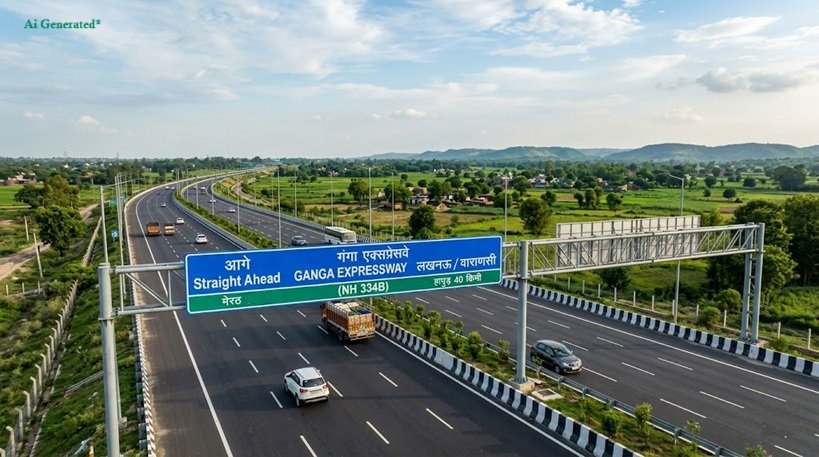
We have seen what this investment looks like on the ground. The Lucknow Metro’s expansion, the Purvanchal Expressway, the Bundelkhand Expressway, the new ring roads, the upgraded airports at Lucknow, Varanasi, and Ayodhya — these are not unrelated to the state’s improving revenue health. When the government collects more, it builds more. And when it builds more, the economy generates more activity, which feeds back into higher collections. UP appears to be in a positive cycle right now.
For the everyday businessperson — the shopkeeper in Aminabad, the manufacturer in Kanpur, the IT professional in Noida — a state with healthy public finances is a state that can invest in the conditions that make business easier: better roads, reliable power, faster administrative services, and growing consumer demand. All of these things are quietly improving across UP, and the GST numbers are one signal of that.
How UP Compares With Other Big States
| State | GST Growth (May 2026) | Trend |
|---|---|---|
| Uttar Pradesh | +13% | 🔼 Highest among major states |
| Haryana | +8% | 🔼 Strong |
| Karnataka | +11% (pre-settlement) | 🔼 Healthy |
| Kerala | +19% | 🔼 Strong |
| Maharashtra | Flat (~0%) | ➡ Stable but no growth |
| Gujarat | +3% | 🔼 Marginal |
| Delhi | -17% | 🔽 Sharp decline |
| Tamil Nadu | -15% | 🔽 Notable decline |
| Rajasthan | -11% | 🔽 Notable decline |
| Assam | -13% | 🔽 Sharp decline |
The table above underlines just how exceptional UP’s performance is. Kerala also grew strongly at 19 percent, but it is a far smaller economy. Among the large, high-population states — Maharashtra, Gujarat, Karnataka, Tamil Nadu, Delhi — none came close to UP’s 13 percent domestic GST growth. This is a genuine milestone.
A Note on the Two-Month Picture
It is also worth zooming out to the first two months of FY 2026-27 (April and May together), because one good month can be noise — two good months start looking like a trend. Across India, gross GST collections for April-May 2026 stood at Rs 4.37 lakh crore, up 6.2 percent over the same period in FY 2025-26. Net revenue for the two months reached Rs 3.78 lakh crore, up 5.5 percent year-on-year.
For UP specifically, tax revenue collections in the first two months of FY 2026-27 reached Rs 41,621 crore against an annual target apportioned for the period. GST collections alone in this two-month window hit Rs 17,334 crore. The state is on a strong trajectory heading into the fiscal year, even as it acknowledges room to grow — the two-month achievement is 62.6 percent of the GST target, meaning the harder months of collection lie ahead, but the baseline is healthy.
From a Lucknow Classroom to the National Stage
I am a teacher by profession. And one thing teaching has given me is the ability to read a report card honestly — celebrating what is genuinely good while staying clear-eyed about what still needs work. UP’s May 2026 GST performance is a genuine A in the subject. The state has outperformed every major Indian economy in domestic tax growth, in a month when the national average went negative. That deserves to be acknowledged and celebrated.
At the same time, UP still has significant ground to cover. The state’s GST collection target achievement of 62.6 percent in two months suggests ambitious targets have been set — and the real test of this momentum will be sustaining it through the remaining ten months of the financial year. Revenue from stamp duty, a key indicator of the real estate and property market’s health, grew only marginally. And the transport sector, while positive, needs deeper expansion as the state’s expressway and logistics network grows.
But the direction is right. The trajectory is upward. And for those of us who have seen UP go from being spoken of as a governance challenge to being discussed as a growth story at national forums — this latest GST data is one more piece of evidence that something real is changing in the state’s economic foundations.
UP is no longer just India’s most populous state. It is becoming one of India’s fastest-growing tax economies. And that matters for every family, every business, every future in this state.
Looking Ahead
The coming months will tell whether May 2026 was a peak or a platform. Nationally, if the adjusted domestic GST growth holds in the 9–10 percent range through FY 2026-27, India could be on track for record annual GST collections potentially crossing Rs 22–23 lakh crore for the full year. UP, as one of the leading contributors and the fastest-growing major state in May, will play a central role in that outcome.
For Lucknow — the capital and the heart of this state — these numbers carry a particular resonance. The businesses on Hazratganj’s heritage promenade, the startups in Lucknow’s growing tech ecosystem, the artisans whose chikan and zardozi work reaches markets across the country, the new manufacturing units coming up along the Lucknow-Agra Expressway corridor — all of them are part of this story. All of them contribute to the GST numbers. And all of them benefit when those numbers are strong.
So the next time someone tells you that UP is still playing catch-up with the rest of India — show them the May 2026 GST data. Number one in the country. Thirteen percent growth. In a month when most of the country was going backwards.
That is not catching up. That is leading.
Disclaimer: This article is based on publicly available GST revenue data released by the Ministry of Finance and UP state government statements for May 2026. It is intended for informational purposes only and does not constitute financial or policy advice.