Lucknow, April 25, 2026 — The state capital of Uttar Pradesh turned into a site of solemn remembrance on Saturday as political leaders, citizens, and dignitaries gathered to honour the memory of one of India’s most distinguished statesmen — Hemwati Nandan Bahuguna — on what would have been his 107th birth anniversary. Floral tributes were offered, heartfelt speeches were delivered, and a collective resolve was expressed to carry forward the legacy of a leader whose contributions to Indian democracy, governance, and the freedom movement remain indelibly etched in the annals of the nation’s history.
CM Yogi Adityanath Leads the Tribute Ceremony
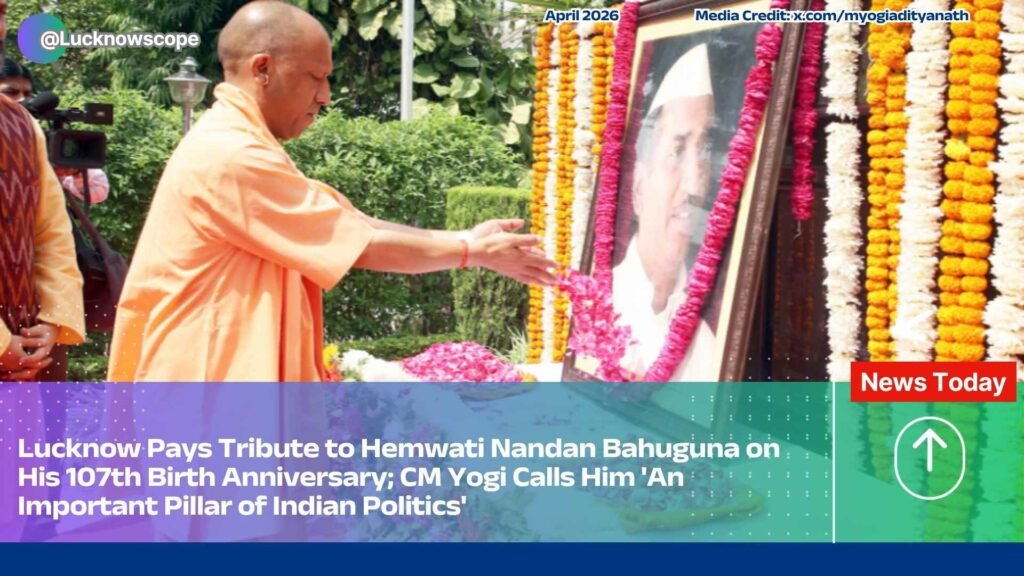
Uttar Pradesh Chief Minister Yogi Adityanath was at the forefront of the commemorative event, paying his floral respects at the statue of the late leader at Yojana Bhawan in Lucknow. Standing before the statue with folded hands, the Chief Minister offered flowers in a solemn act of reverence that set the tone for the morning’s proceedings. Speaking to reporters after the tribute, CM Yogi articulated a deep and considered appreciation for Bahuguna’s multifaceted contributions to the nation.
“Today is the birth anniversary of former UP CM Hemwati Nandan Bahuguna,” CM Yogi said. “On this occasion, I pay my humble tribute to him, honouring his memory on behalf of the UP government. Hemwati Nandan Bahuguna was an important pillar of Indian politics.”
The Chief Minister went on to recall the remarkable arc of Bahuguna’s life — from a young freedom fighter imprisoned by British authorities for his participation in the Quit India Movement, to a seasoned statesman who served Uttar Pradesh and the nation at the highest levels of governance. CM Yogi emphasized that Bahuguna’s vision for Uttar Pradesh’s development was not merely a chapter of the past, but a living legacy — one that continues to shape the state’s growth even today.
“He had his own vision for the development of UP, and we can feel it coming to fruition,” the Chief Minister noted, underlining how several of the former CM’s developmental initiatives laid the groundwork for future administrations.
A Life Rooted in the Hills of Garhwal
Hemwati Nandan Bahuguna was born on April 25, 1919, in the Pauri Garhwal district of what was then a part of undivided Uttar Pradesh — a region that would later become part of the newly carved state of Uttarakhand in 2000. His origins were humble; he grew up in a small village surrounded by the Himalayan foothills, an environment that would shape his grounded sensibilities and his deep connection to the common people of India.
For his higher education, Bahuguna moved to Prayagraj (then Allahabad), one of the great intellectual and political centres of colonial India. It was there, amidst the charged atmosphere of the independence struggle, that a young Bahuguna found his calling. He became an active student leader and was drawn irresistibly into the orbit of the national movement.
His political awakening reached a decisive point during the Quit India Movement of 1942 — Mahatma Gandhi’s landmark call for the British to leave India. Bahuguna joined the movement with full conviction and was subsequently arrested and imprisoned by the British colonial government. Far from breaking his spirit, incarceration only steeled his resolve and deepened his commitment to the principles of democracy, justice, and public service.
A Towering Political Career
After India attained independence in 1947, Hemwati Nandan Bahuguna channelled his energies into the democratic process with the same vigour he had once devoted to the freedom struggle. In 1952, he was elected to the Uttar Pradesh Legislative Assembly for the first time, marking the beginning of a long and distinguished career in elected politics. He contested and won under the banner of the Indian National Congress, the party that had led the independence movement and now steered the newly sovereign nation.
Over the years, Bahuguna rose steadily through the ranks. He served as a Minister in the Uttar Pradesh government, gaining a reputation as a decisive and capable administrator with an abiding concern for social justice and the welfare of ordinary citizens. His skills in governance and his deep grassroots connect eventually propelled him to the highest office in the state.
Hemwati Nandan Bahuguna served as the Chief Minister of Uttar Pradesh from 1973 to 1975 — a turbulent but transformative period in Indian politics. As CM, he worked to raise the profile of development programmes, address social inequities, and push forward administrative reforms. His tenure was marked by an energetic engagement with the issues that mattered most to the people — poverty alleviation, rural development, and expanding access to public services.
Beyond the state, Bahuguna also served in the Union government in multiple ministerial capacities, contributing to national policy-making at the highest level. His experience across different tiers of governance — local, state, and central — made him a uniquely rounded statesman whose perspectives were informed by both the granular realities of ground-level politics and the broad demands of national governance.
Later in his career, Bahuguna made the significant decision to leave the Congress party and join the Bharatiya Lok Dal (BLD), a move that reflected his willingness to put principles above partisan loyalty — a quality that earned him widespread respect across party lines.
Uttarakhand CM Dhami Also Pays Homage
The birth anniversary tributes were not confined to Lucknow alone. In Dehradun, Uttarakhand Chief Minister Pushkar Singh Dhami also offered his respects to the late leader, who is regarded as a cherished son of the region that is now Uttarakhand.
“Today is a big day in Indian politics and in Indian history,” CM Dhami told reporters. He described Bahuguna as someone born into modest circumstances who went on to hold some of the highest offices in the land — a testament to the power of integrity, hard work, and democratic ideals.
Dhami was particularly emphatic about Bahuguna’s commitment to transparent and corruption-free governance. “He worked with transparency and integrity, freeing people from corruption and creating a system that was very comfortable with the people,” the Uttarakhand CM said. He also highlighted Bahuguna’s personal resilience: “He faced numerous challenges many times, but he never bowed down to them, always standing firm.”
CM Dhami further noted that Bahuguna’s legacy continues to live on in the form of institutions and universities named in his honour across Uttarakhand — a tangible reflection of the esteem in which the people of the region hold his memory.
A Legacy That Endures
The tributes paid to Hemwati Nandan Bahuguna on his 107th birth anniversary speak to the enduring relevance of his life and work. In an era when questions of political integrity, grassroots leadership, and inclusive governance are as pressing as ever, Bahuguna’s example offers a powerful and instructive model.
His journey — from the hills of Garhwal to the prisons of the British Raj, from the floor of the UP Legislative Assembly to the corridors of power at the Centre — was defined by a consistent thread: a deep and abiding commitment to the people. He was a leader who understood that political power is not an end in itself, but a means to serve, to uplift, and to transform the lives of those who invest their trust in their representatives.
His role in the Quit India Movement placed him squarely within that generation of Indians who put their liberty and safety on the line for a principle — and who demanded nothing less than full independence for their nation. That formative experience shaped everything that followed: his political conduct, his administrative philosophy, and his personal relationships with those he served.
For the present generation of leaders in both Uttar Pradesh and Uttarakhand, the anniversary serves as an occasion not just for remembrance, but for recommitment. As CM Dhami noted, the goal is to continue working in the direction Bahuguna charted — towards a politics of integrity, a governance of compassion, and a state that puts the welfare of its citizens first.
Dignitaries and Citizens Unite in Remembrance
The event in Lucknow was attended by a cross-section of political leaders and public figures. Former MP Rita Bahuguna Joshi — the late leader’s daughter — was present at the ceremony, along with MLA Dr Neeraj Bora, BJP leader Avinash Trivedi, and other dignitaries. The presence of family members alongside leaders from across the political spectrum underscored the bipartisan respect that Hemwati Nandan Bahuguna commands even decades after his passing.
Citizens too participated in the commemoration, offering flowers and paying their personal respects in a display of public affection that is perhaps the most meaningful tribute a leader can receive — not the formal gestures of protocol, but the genuine gratitude of ordinary people who remember and cherish what was done for them.
Conclusion
Hemwati Nandan Bahuguna was, as CM Yogi Adityanath rightly described him, an important pillar of Indian politics. Born in the mountains of Garhwal, shaped by the fires of the freedom movement, and tempered through decades of democratic service, he embodied the finest ideals of Indian public life. On his 107th birth anniversary, the tributes offered in Lucknow and Dehradun were not merely acts of commemoration — they were affirmations of the values he stood for, and a reminder that great leadership, rooted in integrity and service, leaves a mark that time cannot erase.