
Whenever I take my computer class students on a field trip, someone always asks the same question: “Ma’am, how old is this building?” Most of them expect a single number. The honest answer is usually a range of centuries, several rulers, and a story about how one dynasty built on what another had left behind. Uttar Pradesh is one of the best places in India to learn this lesson, because so much of the medieval history of north India passed through its plains, rivers, and cities.
This article looks at two great chapters of that history, the Delhi Sultanate and the Mughal Empire, and at the buildings they left behind. I have taught history alongside computers for many years, and I have found that students remember architecture far better than dates. So I will try to connect each style to a place you can visit, and to a feature you can actually see with your own eyes.
Who Were the Sultans of Delhi?
The Delhi Sultanate ruled large parts of the Indian subcontinent from 1206 to 1526. The sultans came from Turkish, Afghan, and other Central Asian backgrounds, and they governed from Delhi through a series of dynasties. Historians usually list five: the Mamluk (Slave) dynasty, the Khaljis, the Tughlaqs, the Sayyids, and the Lodis.
Their rule was not always stable. Some dynasties were short-lived, and rebellions were common. Yet the period was remarkably productive in architecture, because these rulers needed to show their power, their faith, and their legitimacy to both subjects and rivals. Buildings were the most visible way to do that.
The early Sultanate builders brought with them the arch, the dome, and the true vault, which were not part of the Indian construction tradition. Indian builders had long used the post-and-lintel system, with columns and horizontal beams. The new arrivals blended their methods with local craftsmanship, and workers who had carved temples for generations soon found themselves carving calligraphy and geometric patterns instead. This meeting of traditions is one of the most interesting threads in our architectural heritage.
The Qutb Complex: Where the Story Begins
Anyone who studies this period must begin in Delhi with the Qutb Minar complex. Construction of the tower is associated with Qutb-ud-din Aibak, the first ruler of the Mamluk dynasty, and work continued under his successors. The tower’s red sandstone and marble bands, its carved inscriptions, and its tapering stories all reveal this blend of cultures.
Near the tower stands the Quwwat-ul-Islam mosque, whose courtyard includes an old iron pillar that visitors have long been fascinated by. Many of the mosque’s columns were taken from earlier Hindu and Jain temples, and you can still see carved figures and motifs on them. For me, this is the most important lesson the site offers. Conquest brought new buildings, but it also reused the materials and craftsmanship of the people who lived there before.
The Khaljis and the Tughlaqs: Power in Stone
Alauddin Khalji, who ruled from 1296 to 1316, was an ambitious builder. His Alai Darwaza, a gateway at the Qutb complex, is famous for its horseshoe arches and its use of fine red sandstone with white marble inlay. He also began a new city, Siri, to hold his power and army.
The Tughlaq dynasty that followed built on a more austere, fortress-like style. Ghiyath-ud-din Tughlaq’s tomb and the fort of Tughlaqabad show massive sloping walls, thick masonry, and a severe look that seems designed to impress through strength rather than decoration. Firoz Shah Tughlaq later built the Firoz Shah Kotla, whose Ashokan pillar was brought from Topra, in Haryana, and placed there. Visitors often find this surprising, and it is a good example of how the Sultans reused and moved older monuments to claim their own heritage.
The Lodi Gardens and the Final Sultanate Style
The last dynasty, the Lodis, governed from 1451 to 1526. Their tombs, now set in the peaceful Lodi Gardens in Delhi, are squarish structures with broad domes and simple, dignified facades. They show a more restrained approach, and they serve as a bridge toward the Mughal style that was about to arrive.
The Sharqi Sultans of Jaunpur: Uttar Pradesh’s Own Chapter
Now, let us turn to our own state. While Delhi was the seat of the Sultanate, the Sharqi dynasty built a powerful independent kingdom centered on Jaunpur, a city on the banks of the Gomti in eastern Uttar Pradesh. It flourished from about 1394 to 1479, and it became a major centre of learning, music, and architecture. Local people often call it the “Shiraz of Hindustan,” a phrase that reflects its reputation for scholarship.
The Atala Masjid, begun in 1408, is one of the most striking monuments in the region. Its large arched screen, or pylon, is decorated with carved patterns, and its design shows a strong sense of proportion. The Jama Masjid of Jaunpur, built in the later Sharqi period, is another fine example, with its massive walls and deep, dark arches.
The Sharqi style is distinct from Delhi’s work in one important way. Builders here often used Hindu-style decorative elements, such as lotus motifs and carved brackets, alongside Islamic calligraphy and geometric designs. For a student of art, this is a wonderful case study in how regional identity shaped imperial architecture.
Jaunpur also gives us a good lesson in continuity. Later, in the Mughal period, the Akbari Bridge, constructed over the Gomti in 1564 by Munim Khan, Khan-i-Khanan, was an important piece of infrastructure. It still reminds visitors that good engineering and good planning were valued across centuries.
The Mughal Arrival: A New Vision
In 1526, Babur defeated Ibrahim Lodi at the First Battle of Panipat and laid the foundation of the Mughal Empire. Babur was a Central Asian ruler of Timurid descent, and he brought with him a love of gardens, water, and symmetry. Though he ruled only briefly, his vision shaped what came after.
The Mughals developed a style that combined Persian, Timurid, Indian, and local traditions into something new. You can see it in the use of red sandstone, white marble, and inlay, in the paired arches and chhatris (domed pavilions), and in gardens laid out in a charbagh, or four-part plan. The style reached its height under Akbar, Jahangir, and Shah Jahan, and Uttar Pradesh holds some of its most important monuments.
Agra: The Heart of Mughal Architecture in Uttar Pradesh
Agra is the city most closely associated with Mughal architecture, and for a teacher from Lucknow, a visit there is always a delight. Akbar began the Agra Fort in 1565, and it was later expanded and decorated by his successors. Its massive red sandstone walls enclose palaces, mosques, and halls, including the Jahangir Mahal and the Diwan-i-Khas. The fort reflects both the power of the empire and its interest in combining royal living with fine design.
Itmad-ud-Daulah’s tomb, often called the “Baby Taj,” is a jewel of inlay work, with intricate pietra dura panels set in white marble. Many experts consider it a bridge between the early and later Mughal styles, and it shows how the use of marble was becoming more refined.
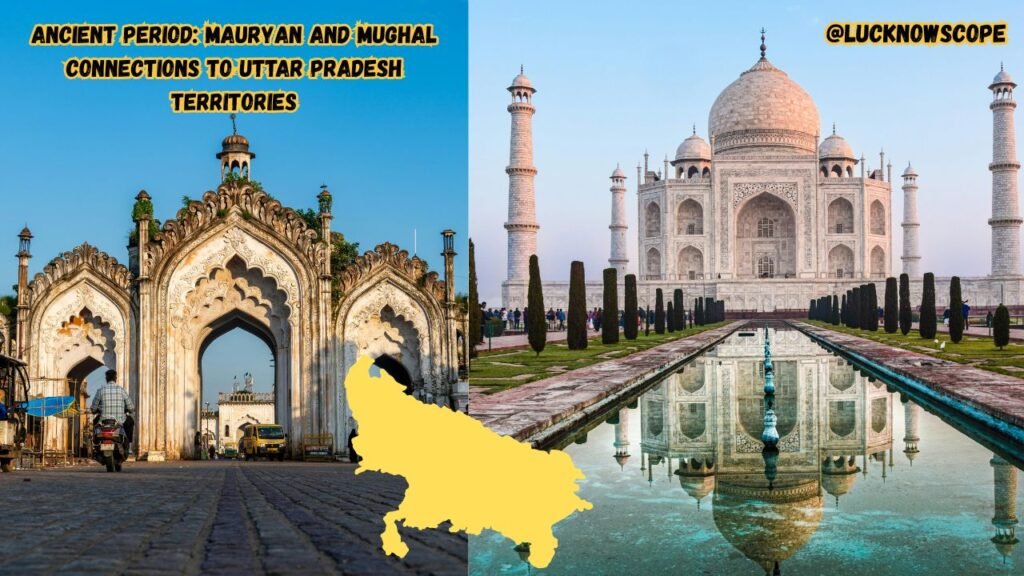
Then, of course, there is the Taj Mahal, built by Shah Jahan between about 1632 and 1653 as a tomb for his wife, Mumtaz Mahal. Its symmetry, its central dome, its four minarets, and its carefully planned gardens represent the peak of Mughal achievement. When I explain the Taj to my students, I often ask them to count the ways its design creates balance. Once they start, they never stop noticing proportions in other buildings.
Fatehpur Sikri: A City Built and Abandoned
Some twenty-five miles from Agra lies Fatehpur Sikri, a city Akbar founded in the late sixteenth century to commemorate his victory and to honour the Sufi saint Shaikh Salim Chishti. Its Buland Darwaza, a towering gateway, stands as one of the most impressive entrance structures in India. The complex includes the Jama Masjid, the Diwan-i-Khas with its unusual central pillar, and palaces that display the mix of Hindu and Islamic design that Akbar encouraged.
Fatehpur Sikri was not kept as the imperial capital for long. Water shortages and other problems led Akbar to move his court, and the city was left largely empty. Today it stands as a remarkably well-preserved ghost town. For students, it is a powerful reminder that even the grandest buildings depend on practical things like water, supplies, and security.
Mughal Tombs and Gardens Beyond Agra
Uttar Pradesh is also home to other notable Mughal sites. The Allahabad Fort, now in Prayagraj, was begun by Akbar in 1583 and stands on the confluence of the Ganga and Yamuna rivers. Its sturdy red sandstone walls and its history as a military and administrative centre make it an important, though sometimes overlooked, monument.
What We Can Learn Today
After many years of teaching, I have come to believe that architecture is one of the best ways to understand history. A single dome, arch, or carved panel can tell us about trade routes, religious beliefs, the availability of materials, and the tastes of the rulers who commissioned it. Students who learn to read buildings often become more curious citizens, more careful observers, and better researchers.
If you wish to explore these sites yourself, the Archaeological Survey of India’s official website is a good place to check timings, entry rules, and conservation notes before your visit. The Uttar Pradesh Tourism department also maintains information about heritage sites across the state. Please verify details on official pages, since opening hours and rules can change.
Our state’s medieval past is not just a subject for textbooks. It is written in brick, stone, marble, and water. The next time you walk through a fort gate or stand under a dome, pause for a moment and look closely. You may find that the building is telling a story that is still relevant to the city and the people around it.


Pingback: 100 Important Topics for State Government Jobs in Uttar Pradesh: What Students Should Know - Lucknowscope