
By Archana Tyagi
When I teach my students about how technology reaches everyday life, I often ask them to check the “Made in…” label on their phone charger, school shoes or a set of bangles at home. Many are surprised to learn how often the answer traces back to a town in Uttar Pradesh. Living in Lucknow for my whole life, I have watched our state’s industrial story change from sugar mills and small workshops to electronics factories, defence corridors and export zones.
This article looks at how Uttar Pradesh’s industrial clusters and Special Economic Zones work, where they are, and why they matter for jobs, exports and the future of cities like ours.
What Are Industrial Clusters and SEZs?
Two terms come up again and again, and they are often confused.
An industrial cluster is a geographic concentration of similar or related businesses, along with their suppliers, skilled workers and support services. Think of a lane in a market where every shop sells the same craft. Over generations, the skills, raw material suppliers and buyers all gather around it. Uttar Pradesh has hundreds of such clusters, many of them centuries old.
A Special Economic Zone (SEZ) is a designated, duty-free enclave treated as foreign territory for trade purposes. It is governed by the Special Economic Zones Act, 2005. Units inside an SEZ enjoy customs and tax benefits and simplified procedures, mainly to encourage exports. The Ministry of Commerce and Industry oversees the SEZ framework, and official information is available at sezindia.gov.in.
In simple terms, a cluster grows organically from tradition, while an SEZ is planned by policy. Uttar Pradesh has a healthy mix of both.
Why Uttar Pradesh Is Well Placed for Industry
As a teacher, I like to explain things in points a student can remember, so here are the state’s key advantages:
- Size and market: UP is India’s most populous state, which means a large domestic market and a deep labour pool.
- Location: It surrounds the National Capital Region on one side and connects the Gangetic plains to central India on the other.
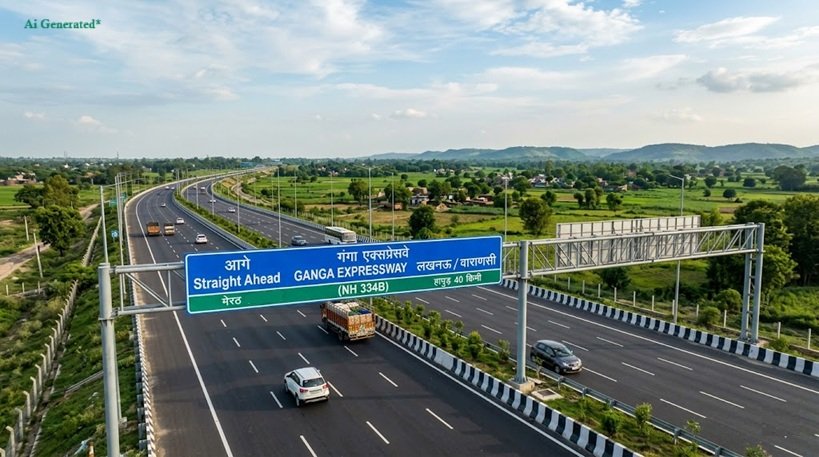
- Connectivity: The Yamuna, Agra–Lucknow, Purvanchal and Bundelkhand Expressways have cut travel times sharply, and the Ganga Expressway is another major project. The Eastern Dedicated Freight Corridor also passes through the state.
- Airports: Lucknow, Varanasi, Kanpur and Gorakhpur are already functioning, and the Noida International Airport at Jewar is a major addition for cargo and passengers.
- Policy support: The state government runs an investor-facing portal at invest.up.gov.in and a single-window system through Nivesh Mitra (niveshmitra.up.nic.in).
The Noida–Greater Noida Belt: The Manufacturing Powerhouse
If someone asks me where modern industry in Uttar Pradesh is most visible, I point to Noida and Greater Noida.
Noida Special Economic Zone (NSEZ) is among the oldest export processing zones in the country. It began in the 1980s as the Noida Export Processing Zone and was converted into an SEZ in the early 2000s. It hosts units in electronics, apparel, gems and jewellery, handicrafts, software and engineering goods. Because it is a central government SEZ, it is administered by a Development Commissioner under the Ministry of Commerce and Industry.
Around it, the region has grown into India’s leading electronics hub. Mobile phone assembly, component manufacturing and consumer electronics have made Noida a name recognised globally. The state’s electronics policies aim to deepen this base by attracting component makers and not just assemblers.
The Yamuna Expressway Industrial Development Authority (YEIDA) area, near Jewar, is where the next wave is planned. Proposals and projects there include a medical devices park, a toy park, data centres, logistics hubs, a film city and semiconductor-related assembly and testing facilities. Details of individual projects change often, so readers should confirm the current status from YEIDA and Invest UP.
The Defence Industrial Corridor
One of the most talked-about projects for our region is the Uttar Pradesh Defence Industrial Corridor (UPDIC), announced in 2018. It has six nodes: Lucknow, Kanpur, Agra, Aligarh, Jhansi and Chitrakoot.
The idea is to build an ecosystem where large defence manufacturers, MSME suppliers and research institutions work side by side. Kanpur already has decades of defence manufacturing heritage through its ordnance establishments. Lucknow has emerged as a node for missile systems manufacturing, with a facility on the outskirts of the city, and it hosts related aerospace and defence projects.
What excites me as an educator is the skill pipeline this creates. Diploma holders, ITI graduates and engineers from local institutions can find local, high-value careers, so fewer young people need to leave their hometowns.
Textile and Apparel: PM MITRA
The Government of India’s PM MITRA (Mega Integrated Textile Region and Apparel) scheme proposed large textile parks across the country. Uttar Pradesh’s park is planned in the Lucknow–Hardoi region. The concept is “farm to fibre to factory to fashion to foreign”, integrating spinning, weaving, processing, garment making and export under one roof. Information on such national schemes is available on the Ministry of Textiles website (texmin.nic.in).
For a state with a large handloom and handicraft tradition, this could connect traditional skills with modern scale.
The One District One Product (ODOP) Story
If SEZs are the new face of UP’s industry, the ODOP programme is its living heritage. Under ODOP, each of the state’s 75 districts is promoted for a signature product, with support for design, marketing, credit and exports. The official portal is odop.up.gov.in.
Some well-known examples of these clusters:
- Firozabad: the glass bangle and glassware capital of India.
- Moradabad: “Brass City,” known for exported metal handicrafts.
- Varanasi: Banarasi silk sarees and brocades, protected by a Geographical Indication (GI) tag.
- Bhadohi–Mirzapur: the hand-knotted carpet belt.
- Aligarh: locks and hardware.
- Meerut: sports goods and musical instruments.
- Saharanpur: wooden furniture and carving.
- Kannauj: attar and perfumery.
- Lucknow: chikankari embroidery and zardozi work.
- Khurja: ceramics and pottery.
- Agra: footwear, leather goods and marble inlay.
- Kanpur and Unnao: leather and leather products.
I should share a small generic example here. A chikankari artisan in a lane of old Lucknow might once have depended entirely on a local trader. Today, with a GI tag, a digital catalogue and an online marketplace, the same artisan can reach a buyer in another country. Cluster development turns this individual story into a community story.
Leather, Sugar and Other Traditional Strengths
Leather is a major employer in Kanpur, Unnao and Agra. It also faces environmental challenges, since tanneries need effluent treatment and compliance with pollution norms. Common effluent treatment plants and modernised clusters have therefore been an important part of the policy conversation. Sustainable processing is essential for the sector’s future.
Sugar and agro-processing remain a backbone of western and central UP. The state is among India’s largest producers of sugarcane, and sugar mills have diversified into ethanol, power cogeneration and by-products. Food processing parks and cold chains are growing, which helps farmers get better returns for potatoes, mangoes, dairy and grains.
Lucknow’s Own Industrial Landscape
For Lucknow readers, the industrial areas of Amausi, Sarojini Nagar, Chinhat, Transport Nagar and Sitapur Road are familiar names. Alongside them, the city has developed as an IT and services centre, with the IT City and its surroundings hosting software firms and startups. Many of my former students work in these sectors, some in computer-related roles that did not exist in our city two decades ago.
The industrial development authorities matter here. Bodies such as UPSIDA (Uttar Pradesh State Industrial Development Authority) allot plots, develop infrastructure and manage industrial areas across the state. Details are available at upsida.up.gov.in.
Other Growth Regions
Bundelkhand: The Bundelkhand Expressway and the Jhansi node of the defence corridor aim to bring industry to a region that has historically lagged in development.
Purvanchal: Gorakhpur, Varanasi and the eastern districts are benefiting from the Purvanchal Expressway, along with new industrial authorities. Gorakhpur’s industrial area (GIDA) is an example of eastern UP’s new manufacturing base.
Western UP: Ghaziabad, Meerut, Muzaffarnagar and Saharanpur have long histories of engineering, paper, steel, sports goods and agro-based industry. Their proximity to Delhi–NCR continues to attract logistics and warehousing.
The Policy Backbone
The state’s Industrial Investment and Employment Promotion Policy offers incentives such as capital subsidies, stamp duty benefits and support for employment generation. Sector-specific policies exist for electronics, semiconductors, textiles, IT, data centres, food processing and more. The state also organises investor summits and ground-breaking ceremonies to convert investment intentions into actual factories. The Government of India’s DPIIT (dpiit.gov.in) and MSME Ministry (msme.gov.in) provide the national framework on which these state policies are built.
I always tell readers to treat headline investment numbers carefully. A signed MoU is an intention, and a functioning factory with employees is the outcome. The real measure of success is how many projects are actually completed and how many jobs they create.
Challenges That Deserve Honest Discussion
An article that only praises would not be fair to readers, so let me note the challenges:
- Skills gap: Industry needs trained technicians, machine operators and digital-skilled staff. Many graduates still need practical training.
- Environmental concerns: Sectors like leather, dyeing and sugar need strict pollution control, particularly along rivers such as the Ganga and Yamuna.
- MSME finance: Small units in traditional clusters often struggle with credit, technology upgrades and market access.
- Uneven regional growth: The NCR belt is far ahead of eastern and Bundelkhand regions, though new expressways are narrowing the gap.
- Land and logistics: Land acquisition, power reliability and last-mile connectivity still affect how quickly projects move.
- SEZ relevance: SEZs nationwide have seen mixed results, and the sector has been changing as the government considers new frameworks and export-focused reforms. Investors should verify current benefits instead of assuming older rules still apply.
What This Means for Common People
Behind every policy is a family. For a young person in a small UP town, industrial growth can mean a job in a nearby factory instead of migrating to a metro. For an artisan, it can mean better prices and recognised branding. For a small shopkeeper near a new industrial area, it can mean a growing customer base. For a student, it can mean internships and career paths right in the state.
If you are a student or job seeker, I would suggest three practical steps:
- Explore skill-training options through government skilling initiatives such as Skill India (skillindiadigital.gov.in).
- Look at what your own district’s ODOP product is and whether related training or schemes exist.
- Build digital skills, because even traditional industries now need people who can handle online sales, accounts and data.
If you are an aspiring entrepreneur, start by checking the MSME registration process on udyamregistration.gov.in and the state’s investor support through Nivesh Mitra.
Looking Ahead
Uttar Pradesh’s industrial future will likely rest on three pillars: high-tech manufacturing in the NCR belt, defence and aerospace along the corridor nodes, and strengthened traditional clusters across its districts. The expressways and freight corridors are the arteries connecting them, and skilled people will determine how well the whole system works.
What I find most hopeful is that the state’s story is not only about big factories. It is also about a weaver in Varanasi, a lock maker in Aligarh and a glass worker in Firozabad who now have better chances to grow. When policy respects tradition and welcomes technology, everyone benefits.
A Note on Sources
The information above is compiled from publicly available government sources and general knowledge of the sector. Projects, policies, incentives and SEZ notifications change frequently, so please confirm current details from official portals such as sezindia.gov.in, invest.up.gov.in, upsida.up.gov.in and odop.up.gov.in before making any business or investment decision.
Archana Tyagi is a computer teacher, educator and writer based in Lucknow, writing for Lucknowscope.com.

Pingback: 100 Important Topics for State Government Jobs in Uttar Pradesh: What Students Should Know - Lucknowscope